
Welcome to the captivating realm of inscriptions found on monetary objects. Every marking tells a unique story that spans centuries of human civilization. These tiny pieces of metal carry powerful narratives about our past.
Throughout history, societies have stamped meaningful words onto their currency. This practice conveyed authority and commemorated important events. It also established monetary value across different cultures.
When you examine historical currency, you’re seeing a direct communication from ancient times. Latin inscriptions on Roman denarii, Arabic script on Islamic dirhams, and Chinese characters on ancient cash pieces all reveal fascinating details. They tell us about rulers, religions, and societies that created them.
In our modern era, the concept of currency has evolved dramatically. Digital platforms now use coded communications as part of their security systems. Understanding these notifications helps people manage their digital holdings safely.
This comprehensive guide will help you appreciate both historical inscriptions and contemporary digital communications. You’ll learn to decode ancient markings while staying informed about modern security practices.
Key Takeaways
- Currency inscriptions provide direct insights into historical civilizations and their values
- Ancient markings reveal information about rulers, religions, and societal structures
- The concept of monetary objects has expanded to include digital platforms
- Understanding modern coded communications is essential for digital security
- Decoding skills apply to both historical artifacts and contemporary systems
- Proper interpretation helps collectors identify origins and authenticate pieces
- Security awareness protects against potential digital threats in modern systems
Exploring the History and Significance of Coin Inscriptions
Ancient rulers discovered that stamped metal could carry messages across empires and generations. These markings served as powerful tools for communication and control. They transformed simple metal discs into carriers of cultural identity.
Historical Context and Cultural Impact
Early civilizations like the Lydians began this process in the 7th century BCE. They created standardized currency with identifying marks. Rulers quickly realized inscriptions could legitimize their authority.
This practice spread across cultures, each adding unique elements. Roman pieces featured complex abbreviations understood as a special code. Greek city-states displayed their names and patron deities proudly.
Medieval European currency carried religious phrases like “DEI GRATIA.” These markings helped spread literacy and standardize languages. They created shared symbolic vocabulary across vast trading networks.
Understanding the Symbolism Behind Ancient Texts
Each inscription contained multiple layers of meaning. Political legitimacy blended with religious devotion in compact spaces. Economic information shared space with cultural identity markers.
The numbers on these artifacts often indicated regnal years or important dates. This data provided context about their creation. The credit of issuing authorities was reinforced through guaranteed purity statements.
Different civilizations developed distinct styles that became part of their numismatic heritage. Chinese pieces featured square holes with four-character inscriptions. Islamic currency displayed beautiful calligraphic religious declarations.
Understanding these symbols requires seeing them as more than simple identification. They were propaganda tools reaching even illiterate populations. Each marking told a story about the society that created it.
How to Decode the Text from Coin Inscriptions
Unlocking the secrets of historical currency markings involves systematic analysis and careful observation. This investigative journey combines multiple disciplines into a rewarding process of discovery.
Gathering Contextual and Historical Clues
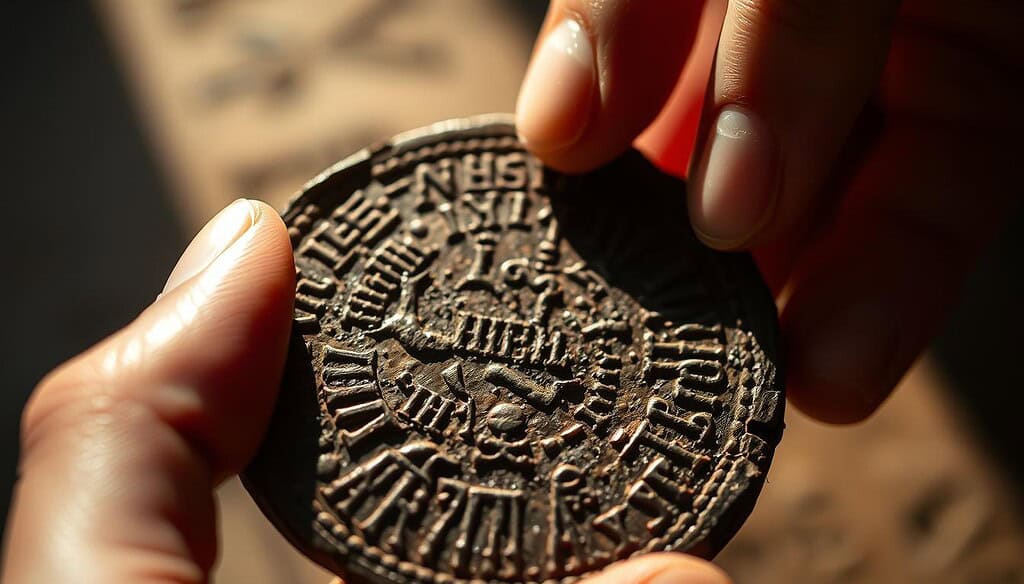
Begin your investigation by examining the physical characteristics of your artifact. Look at portrait styles, symbols, and mint marks. These elements work together as a team to reveal important clues.
Analyzing Linguistic Patterns and Symbols
Recognize common abbreviations like “IMP” for Emperor or “REX” for King. Understanding these patterns is a crucial part of successful interpretation. Look for date numbers that indicate specific historical periods.
Utilizing Reference Materials and Expert Tips
Consult specialized databases and numismatic resources. These references contain valuable data about millions of artifacts. Cross-referencing multiple sources helps verify your findings.
“The language of ancient currency speaks across centuries to those who learn to listen.”
Here’s a comparison of decoding approaches:
| Approach | Focus Area | Resources Needed |
|---|---|---|
| Visual Analysis | Symbols & Portraits | Magnification Tools |
| Historical Context | Time Period | Chronological Guides |
| Linguistic Study | Language Patterns | Translation References |
Follow these expert tips for better results. Always document your findings systematically. This organized process leads to more accurate interpretations over time.
Recognizing and Preventing Scam Texts and Phishing Attempts
In today’s digital world, protecting your assets requires awareness of modern threats. Just as ancient inscriptions conveyed authority, fraudulent communications now aim to deceive. A recent surge in phishing scams targets cryptocurrency holders with convincing but fake alerts.
These scams often arrive as unsolicited messages about account activity. They create a false sense of urgency to provoke quick action.
Identifying Red Flags in Unsolicited Texts
Be cautious of messages claiming there’s an issue with an account you didn’t access. Look for international phone numbers, especially those starting with +63. Legitimate companies will not send verification codes without a request.
Another warning sign is a message that provides a phone number to call immediately. Scammers use this tactic to bypass your caution.
Best Practices for Two-Factor Authentication and Security
Two-factor authentication (2FA) is a powerful security tool. However, its codes are a prime target for thieves. Never share these codes with anyone, as legitimate support will never ask for them.
“Security is not a product, but a process. It’s about staying one step ahead of those who wish to cause harm.”
Always initiate contact through the official company website. Do not use links or numbers provided in suspicious communications.
Reporting Suspicious Messages and Protecting Personal Data
If you receive a suspicious message, delete it immediately. Do not respond or call any numbers listed. Report the attempt to the legitimate company’s security team.
Here’s a quick guide to handling potential phishing attempts:
| Action | Do This | Do Not Do This |
|---|---|---|
| Receive Unsolicited Message | Delete it | Reply or call |
| Verify Account Issue | Visit official website | Use provided links |
| Report Phishing | Contact company security | Ignore the attempt |
Stay vigilant and protect your personal information across all platforms.
Conclusion
Deciphering messages on currency offers a unique window into human civilization. These markings connect us to ancient rulers and modern security systems alike.
Understanding these communications requires knowledge and critical thinking. Historical inscriptions provide direct connections to past societies. Proper decoding unlocks fascinating stories about human development.
The credit for preserving this knowledge belongs to dedicated experts. A global team of researchers has cataloged millions of artifacts. Their work makes identification possible for everyone.
Modern security awareness mirrors ancient verification principles. Both require careful analysis and source verification. This skill protects against deception in any era.
Combining historical appreciation with security awareness creates confident engagement. This approach serves as an essential part of responsible interaction with financial systems across time.