
The idea of Texas independence gained serious momentum last year. Supporters of the Texas Nationalist Movement made a major push to get the question on the ballot.
In November, the group held its first-ever conference in Waco. This event brought together about 100 supporters, leaders, and even some lawmakers. They discussed the future of the state as a potential independent nation.
The central goal of this movement was a signature drive. Organizers aimed to collect enough names to place a non-binding referendum on the Republican primary ballot. At the Waco event, they announced gathering over 60,000 signatures.
Despite a tight deadline, the drive continued with great energy. The group ultimately submitted what it claimed were around 140,000 voter signatures. This effort, though later rejected on procedural grounds, was seen as a significant step forward for the cause of independence.
Founded in 2005 by Daniel Miller, the movement viewed 2023 as a pivotal year. It demonstrated growing public interest and organized support for the Texit concept across the state.
Key Takeaways
- The Texas Nationalist Movement held its first major conference in Waco in late 2023.
- A primary goal was a signature drive for a non-binding secession referendum.
- The movement announced collecting over 60,000 signatures at the conference.
- They ultimately submitted approximately 140,000 signatures to state Republican officials.
- The signatures were rejected on procedural grounds, but supporters saw the effort as progress.
- The organization, founded in 2005, viewed the year as building crucial momentum.
Overview of Texit 2023 Developments
Waco, Texas hosted a landmark gathering that energized supporters of state sovereignty. The Texas Nationalist Movement organized its first major conference at the Waco Convention Center. Approximately 100 people attended this three-day event.
Key Events from the Waco Conference
Speaker Claver Kamau-Imani presented a visionary outlook for an independent Texas. He promised no taxes, unlimited freedom, and doubled economic growth. His speech ignited enthusiasm among attendees.
State Senator Bob Hall and former representative Kyle Biedermann addressed the crowd. Their participation showed growing political support for the cause. Biedermann pledged to reintroduce secession legislation if reelected.
Conference panels covered diverse topics from Texas culture to cryptocurrency. Discussions highlighted concerns about federal agencies like the FBI. This diversity reflected the broad appeal of the movement.
Voter Signatures and the Republican Primary Debate
The signature drive became the year’s most important effort. Organizers needed about 100,000 valid signatures from voters. This would place a non-binding referendum on the Republican primary ballot.
Steve Ravet noted dramatic growth in public backing. Support jumped from one in five people to four in five showing interest. The group ultimately claimed nearly 140,000 signatures.
Despite procedural rejection, supporters considered the campaign a victory. It demonstrated the movement’s organizational strength and growing grassroots appeal across the Lone Star State.
Historical Perspectives and the Evolution of Texas Secession
Long before modern movements, Texas established a pattern of seeking self-governance. The state’s unique history as a sovereign nation began in 1836 when it declared independence from Mexico.

From the Republic of Texas to the Confederacy
Texas existed as the Republic of Texas from 1836 to 1845. This independent nation faced significant challenges before joining the United States. The United States initially denied Texas entry due to slavery concerns.
In 1861, Texas pursued secession again by leaving the Union for the Confederacy. This decision marked the second major Texas secession in just over twenty-five years. The Civil War era demonstrated how secession remained part of Texas political identity.
The 1990s saw another independence movement emerge. The Republic of Texas group claimed the state was never legally admitted to the union. Leader Richard McLaren’s standoff in 1997 showed how extreme these beliefs could become.
Historian Walter Buenger offers critical perspective on the original Republic of Texas years. He called that period “a disaster” for the young nation. The independent nation struggled with taxes, defense, and foreign policy.
Modern advocate Daniel Miller presents a different view. He argues Texas qualifies as a “stateless nation” with distinct cultural identity. Miller points to the Texas Constitution as supporting self-rule claims.
| Secession Attempt | Years | Key Figure | Outcome |
|---|---|---|---|
| Republic of Texas | 1836-1845 | Sam Houston | Joined United States |
| Civil War Secession | 1861 | Governor Houston | Rejoined Union 1865 |
| 1990s Movement | 1990s | Richard McLaren | Violent standoff |
These historical events show how Texas secession has evolved over time. Each attempt reflects changing attitudes toward the United States federal government. The Lone Star flag has symbolized independence aspirations for generations.
The Texas Constitution remains central to modern arguments. Supporters see it as evidence the star state retains special status. This legal framework distinguishes current movements from past efforts.
Legal and Constitutional Implications
The legal path to Texas independence faces substantial constitutional hurdles from the very beginning. These challenges stem from both historical Supreme Court rulings and contemporary election law disputes.
Supreme Court Rulings and Texas v. White
The U.S. Supreme Court established a critical precedent in the 1869 case Texas v. White. This landmark decision declared that states cannot unilaterally secede from the Union.
Legal experts widely consider this ruling definitive. However, movement leader Daniel Miller challenges this interpretation. He argues the Constitution contains no explicit ban on secession.
Challenges with Electronic Signatures and Election Codes
The signature controversy created another legal obstacle for the movement. State GOP officials rejected approximately 140,000 voter signatures collected for the republican primary ballot.
Officials cited procedural issues and invalid electronic signatures. The group argued Texas law permits digital signatures under the Uniform Electronic Transactions Act.
Republican Chairman Matt Rinaldi countered that electronic signatures threaten election integrity. He referenced concerns about voter registration security in his rejection.
The Texas Supreme Court quickly denied the group’s emergency petition. This ended the immediate effort to place the referendum question on the ballot.
This legal dispute highlights how election law complications can derail secession efforts. The controversy shows the complex interplay between constitutional questions and practical election procedures.
Political Reactions and the Texas Nationalist Movement
Political reactions to the Texas secession movement reveal deep divisions within the state’s Republican party. The Texas GOP has shown mixed responses to this controversial issue.
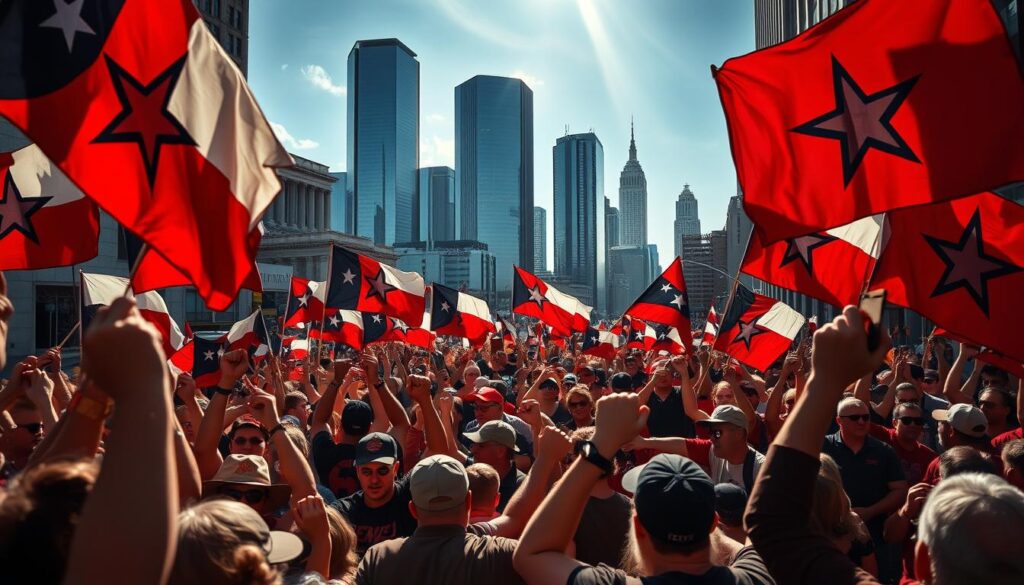
Texas GOP’s Response and Party Dynamics
Delegates at the 2022 state convention successfully added a plank to the party platform. This called for a voter referendum on secession after previous failures in 2016 and 2020.
Three conservative primary challengers to Governor Greg Abbott participated in a Texas Nationalist Movement town hall. These included former state Senator Don Huffines and former GOP chairman Allen West.
More than 60 Republican candidates and two dozen officeholders signed the “Take Texas Back” pledge. Signatories included Agriculture Commissioner Sid Miller and candidate Jack Reynolds.
Kyle Biedermann introduced a bill in 2021 to create a referendum committee. He promised to refile similar legislation if re-elected.
State Representative Jeff Leach called a secession referendum bill “the very definition of hypocarious and seditious treason.” A supporter later sued Leach for defamation over these comments.
Insights from Daniel Miller and Movement Leaders
Daniel Miller founded the Texas Nationalist Movement in 2005. The sixth-generation Texan built the organization from a small advocacy group.
The movement now claims 210,000 Facebook followers. Miller says the group taps into sentiments ignored by mainstream media.
GOP chairman Matt Rinaldi expressed respect for supporters. He questioned why secession is discussed before challenging federal authority through other means.
Political experts note that while few Republican voters support actual secession, many want greater state autonomy. This frustration with the federal government makes the idea appealing.
The party faces internal tensions over this issue. Some see it as a right worth exploring, while others view it as extreme.
Conclusion
The conversation around Texas self-governance has reached an unprecedented level of mainstream political discourse. Despite recent legal setbacks, the movement for independence shows no signs of slowing down. Supporters remain committed to their vision of a new Texas with status independent from the United States.
Looking ahead, organizers plan to file the Texas Independence Referendum Act in the 2025 legislative session. They express confidence that voters will eventually have the right to decide if the state should secede. This referendum would determine whether Texas pursues becoming an independent nation.
However, significant economic challenges await any new Texas nation. Experts estimate the government would need to replace approximately one-third of its budget currently provided by federal funds. This could require finding $9,000 per person annually through new taxes.
Many people, including Texas veterans, express strong opposition to secession. As one Iraq War veteran stated, “I was born in America. And I will die in America.” Another emphasized that “there is strength in numbers” when facing challenges.
The debate over whether Texas should secede reflects broader political trends and regional identities. While legal barriers make actual secession unlikely soon, the conversation has gained significant traction. The movement has successfully brought the idea of state independence into mainstream political discussions.
Ultimately, the question of Texas sovereignty remains deeply divisive. Both sides present compelling arguments about the state’s future relationship with the federal government. The coming years will reveal whether this support for secession grows or recedes.